Facts
Performance marketing has been the buzzword for the last two decades, and CFOs are finally in love with marketing. The explosion of media and online selling has enabled tracking and attribution models to provide accurate ROAS by channel. Effective performance marketing channels have now gone full circle—from the EU Directive on GDPR, through social tags and GA4, to more recent cookie opt-outs, AI’s impact on unsolicited emails. Recently, sponsored ads have started falling below AI overviews, which include high-level recommendations.
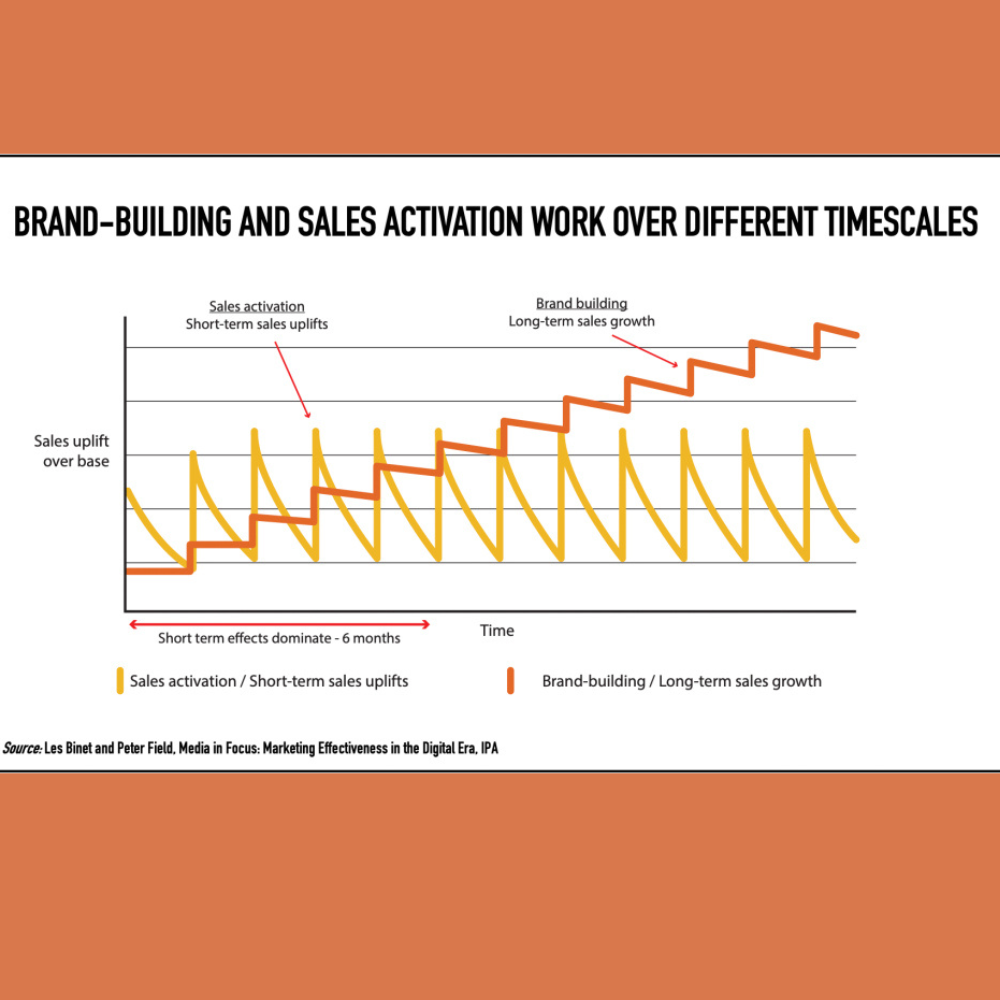
It is proven time and time again that performance marketing drives conversions for the 5% of your audience who are shopping and have high intent in their search. Similarly, it is proven that performance marketing kills growth.
WARC Research in 2024 shows:
- 69% of budget allocation is on performance spend (bottom of the funnel)
- 30% on brand
AI generative engine optimization (GEO) is now dictating brand visibility in AI search engines. Fueled by brand content, brand stories, brand PR, brand endorsements, and brand reviews, AI is now the “shop window” for brand authority. Brand planning is as important as ever now, and it’s time to allocate more budget towards brand activity to drive trust and top-of-the-funnel customer acquisition.
Learnings
Brand propositions have moved from linear hierarchy to looped iterations:
- Express your brand: Resolve a series of unmet needs through brand benefits.
- Tailor your brand message by audience.
- Amplify your brand across relevant channels to like-minded people and gather feedback.
- Evolve your proposition in real-time.
Brand content is more important than ever to ensure you drive brand authority and visibility within AI search. In doing so, it’s important that online content isn’t just another sales tool. Consumers are always at different points of the buying journey and require different information at different touchpoints. Remember, only about 5% of your audience is ready to buy at any time—95% are still in discovery mode or future customers.
A great guide is to build a balanced content plan with:
- 60% TEACH: Educate them with no sell. Possibly a download of useful information.
- 20-30% PROVE IT: Evidence-based benefits of the product/service (e.g., testimonials or performance uplifts).
- 10-20% SELL IT: Demonstrate your products with videos—bring them to life. Have clear links to purchase (Shopify, web shop).
Binet & Field Models suggest that the ideal ratio of investment is 60% brand and 40% sales. Drive the long-term brand story and invest in outreach to your ideal customer profile. Earned traffic always delivers the best ROAS. If you are in a saturated and competitive market, paid search is inevitable, focusing on high-search-volume or niche, low-cost long-tail terms.
How Do You Measure Brand Investment?
Marketers will always butt heads with CFOs on this, as brand investment is a long-term differentiator, seldom amongst active buyers. You are laying down your differentiators and developing brand trust at an early stage to maintain top-of-mind awareness when they enter the buying cycle. You stop chasing leads, and ideally, they find you.
Long-term, the cost of acquisition diminishes as buyers already believe. Brand awareness and engagement are hard to measure and track through channel attribution, as it is a layered effect. The two best measures are annual:
- Total revenue divided by total marketing demonstrates the effect of ROI.
- % of branded search traffic
Branding drives pricing power: The stronger your brand, and the relative trust and recognized benefits, the greater the warranted margin. Comparison tables in online content with features, benefits, and pricing are a great way to establish brand differentiation and AI ranking. It also helps the customer journey and saves them the trouble of shopping around.
You don’t have to be the cheapest or have the most features, but be confident in where you sit in your market space and boldly share that information with AI platforms and your customers.
It’s Time to Be Brave with Your Brand
Deloitte research shows that brands that take risks, evolve, and differentiate are 33% more likely to see long-term revenue growth and 4 times higher profit margins.
Too many companies are focusing on short-term sales and tactical marketing. Why?
- They haven’t planned with brand and differentials in mind, so are less prepared in times of economic pressure.
- There is an insight famine. Companies are not investing in research and gaining feedback to inform and iterate their brand development.
- There is a cultural lag in curiosity, reacting to new trends, or implementing behavioral change models through customer experience.
As the old adage says, “Do as you have always done, and you will get what you have always got.” Yet, there is nothing constant about environmental and economic change.
The Affection-Action Gap
Brands that are relevant to customer needs and innovate solutions for unmet needs close the “affection-action gap.” Well-established brands that are well known and often loved but start to stagnate and customers stop buying—e.g., WHSmiths, Pizza Hut, Clairs, Poundland, Hobbycraft, The Body Shop, Wilko’s—need I continue?